
Guide
Kruspe & Geyer horns: What's the difference?
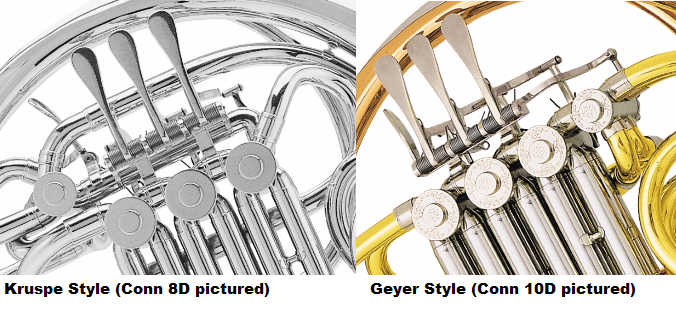
Most double French horns are loosely described as either Kruspe-style or Geyer-style. Those names come from Edward Kruspe and Carl Geyer, two important figures in horn design. The labels are useful, but they are shorthand. A horn's wrap is only one part of how it plays.
Over the years, makers have copied, modified, and blended these layouts to suit different sounds and players. That is why two horns with the same general label can still feel very different. Bell size, metal, leadpipe, valve design, bore, taper, and build quality all matter.
Player notes
Have you played a horn we should know about?
Add a few notes about response, tone, intonation, or fit. Your experience can help someone else make a better choice.
Geyer-style horns
Carl Geyer was a German-born American maker who worked in Chicago and became especially influential in American horn design. What players now call a Geyer-style horn usually has a more open-looking wrap with the Bb change valve placed in line with the main valve section. Many players associate this layout with a more direct response, clean attacks, and a tone that can feel focused or flexible.
Common examples in this conversation include Yamaha 667 and 671-style horns, Conn 10D and 11D-style horns, and many modern custom horns. That does not mean every Geyer-style horn is bright, small, or easy. It only gives you a starting point for comparison.
Kruspe-style horns
Edward Kruspe's designs led to another important horn family. Kruspe-style horns are often associated with the Conn 8D, Holton Farkas-family horns, Hans Hoyer 6801/6802, and Yamaha 668II-type designs. The wrap is more compact around the change valve and often pairs with a larger tonal concept.
Players commonly describe these horns as broader, darker, or more covered, though that depends heavily on the individual model and player. The Conn 8D is the classic American reference point, but not every Kruspe-style horn is an 8D copy.
Is one better?
No. This is where horn players can get too doctrinaire. Some orchestras, teachers, and regions have preferences, and those preferences can matter if you are studying seriously. But the best layout is the one that helps the player make the sound, articulation, intonation, and musical choices they need.
A student moving from a Holton or Conn 8D-style horn may feel more at home on another Kruspe-style horn. A player used to Yamaha 567/667/671-style horns may find a Geyer-style horn more familiar. But a label should never replace trying the actual instrument.
What to listen for
- Response: does the horn start cleanly in soft and loud playing?
- Center: do notes settle naturally or feel slippery?
- Color: does the sound fit the ensemble and repertoire?
- Projection: does it carry from the hall, not just under the bell?
- Intonation: are the tendencies manageable for the player?
- Comfort: does the horn balance well in the hands?
Bottom line
Kruspe and Geyer are helpful comparison terms, not verdicts. Use them to organize your search, then let the individual horn and player decide. If you have played both styles, add a review to the model pages so other players can compare real-world experience instead of just wrap labels.